Part 5. Finishing touches
21 Which plan, and when it pays for itself
Flat prices, no commission on your revenue. What each plan really includes, the arithmetic that tells you when to move up, and the reasons to stay where you are.
We charge a flat monthly price and take nothing from what you earn. An app that takes a percentage costs you more precisely when it works, which we think is the wrong way round.
Each plan includes everything in the one before it.
What each plan is for
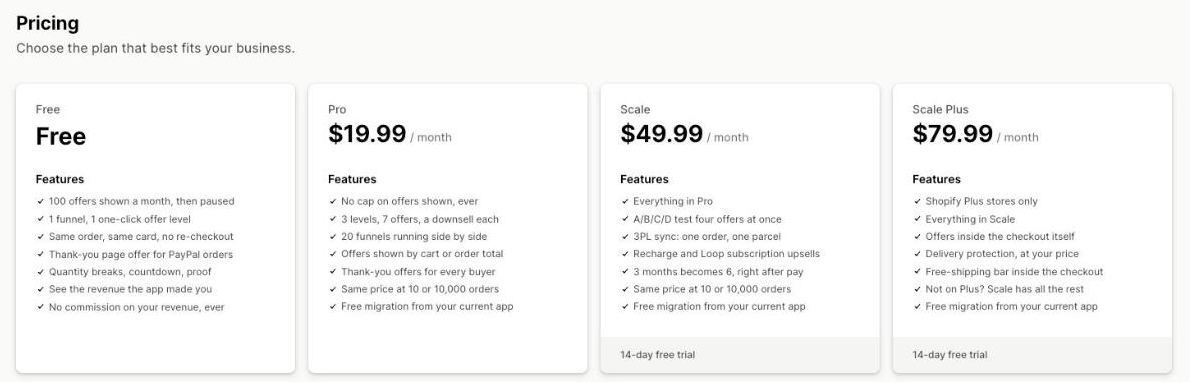
Free. One funnel, one offer shown per order on the one-click page, and 100 offers shown per month there. The thank-you and order status pages do not count toward that limit. On the thank-you page, Free shows your blocks to every buyer. Sorting buyers by what happened on the one-click page (did not see it, accepted, refused) comes with Pro and above. The order status page shows your blocks to everyone. This is enough to find out whether post-purchase selling works in your store at all.
You are warned at 50, 70 and 90 percent of that limit, in the app and by email. At 100 the one-click offer stops until the 1st of the next month. Your orders are not affected: buyers simply see one page less.
Pro, 19.99 a month. Unlimited offers shown, up to three offers per order on the one-click page (seven configured in the tree), up to 20 funnels with conditions, and the thank-you page for every buyer, including the rules about what they accepted or refused on the one-click page. This is the plan most stores stay on.
Scale, 49.99 a month. Everything in Pro, plus A/B testing on every surface, the Picqer connector with its order hold, the Recharge and Loop connections, and the setting that makes buyers pay the price shown even with a discount code. Take it when you have a warehouse system or a subscription app to plug into, or when you are ready to test rather than guess.
Scale Plus, 79.99 a month. Everything in Scale, plus the checkout: offer blocks from your funnels, delivery protection, the stock check, the free shipping bar, the badge, the slider and the progress card, from chapters 17 and 18. Shopify Plus stores only, and worth nothing to anyone else.
The only sum that matters
Take what an accepted offer leaves you after its discount and after the cost of the product and its handling: your margin on it, not its price. Divide the monthly price by it. That is how many extra acceptances a month the plan needs to pay for itself.
An example with round figures. An offer sells for 30 after the discount, and you keep 12 once the product is paid for. Pro at 19.99 pays for itself with two acceptances a month. If your free month produced more than that, the plan pays for itself before you count anything else.
Do the same before moving to Scale. Going up 30 a month for A/B testing is worth it when a winning test lifts your acceptance rate by a point or two on real volume, and it is not worth it when you have five acceptances a month to compare.
Going back down
You can leave a plan whenever you like, and the link to change it stays visible at all times. Nothing you built is deleted when you do. Funnels, blocks, tests and connector settings stay in place, the parts your new plan does not include simply stop being served, and coming back switches them on again unchanged.
Do not upgrade to fix a quiet month. If your offers are not being accepted, a bigger plan will show the same offers to the same buyers. Go back to chapter 5 and change what you are offering. That is free, and it is where the money is.
That is the guide
You have a live funnel, a thank-you page that catches the buyers Shopify skips, numbers you can read, and a way to test one idea against another.
If something here was wrong, unclear or out of date, tell us at support@abakira.com and name the chapter. We answer, and we fix the page.
Last updated