Part 3. Measure, then multiply
13 Different offers for different carts
One funnel cannot serve a 20 order and a 900 order well. How priority and conditions pick the right one, and the mistake that makes blocks look broken.
A single funnel treats every buyer identically. That is fine at the start and wrong soon after, because the right offer for a 20 euro cart is not the right offer for a 900 euro cart.
The Pro plan allows up to 20 funnels. You will not need 20. The Free plan serves one funnel and ignores conditions: with targeting off, your one funnel is shown to everyone.
How the right funnel is chosen
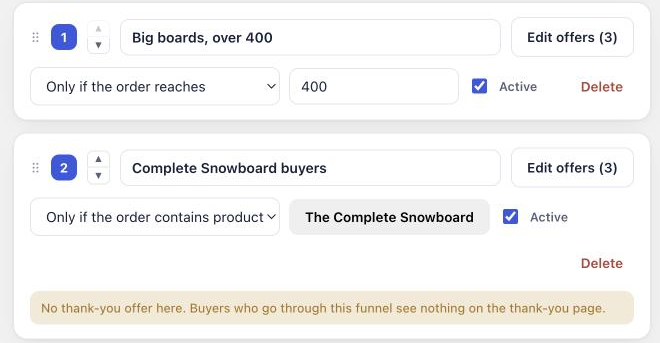
Each funnel has a priority and a condition. When an order comes in, the app walks the list from the top and serves the first funnel whose condition matches. One funnel per order, never two.
There are two kinds of condition: the order total is at least an amount, or the order contains a product. For “contains” you can pick a whole product or only some of its variants. When the app cannot read a condition with certainty, it shows the funnel rather than hiding it.
So order them from the most specific to the most general, and keep one at the bottom with no condition at all. That last one is your catch-all, and without it some buyers meet nothing.
A funnel with no condition matches everyone, so anything below it is never reached. The list warns you when that happens, with “Never shown: a funnel above applies to everyone”. Move the catch-all down, or give it a condition.
The choice holds on every surface. The funnel a buyer goes through is the one whose blocks they meet on the thank-you page, and in the checkout on Plus. The order status page picks its funnel the same way, from the order.
Splits worth making
By cart value. The most useful split, and usually the only one you need. High carts get a higher-priced companion, small carts get something cheap.
By product. When you sell across unrelated categories, a buyer of one has no business seeing an accessory for the other.
Name your funnels properly while you are at it. A list of untitled funnels becomes unreadable within a month, and it makes the problem below much harder to diagnose.
Blocks live inside their funnel. Worth repeating from chapter 7, because it is our number one support question. A block you built in one funnel does nothing for a buyer routed to another. When a block appears dead, first ask which funnel that buyer went through.
Do not split too early
Every split divides your data. Four funnels means each one takes four times as long to tell you anything, and you will be guessing again.
Start with two: one for your high carts, one catch-all. Add a third only when a funnel has enough acceptances that you trust its numbers.
What you should have now
Two or three named funnels in deliberate order, with a catch-all at the bottom, and a check that every funnel you rely on has its own blocks on the thank-you and order status pages.
Last updated