Upsell vs cross-sell: which to offer after checkout
An upsell sells more of what the buyer chose; a cross-sell adds a related product. Which to offer after payment on Shopify, and how to measure it.
2026-11-06 — Abakira, updated 2026-11-11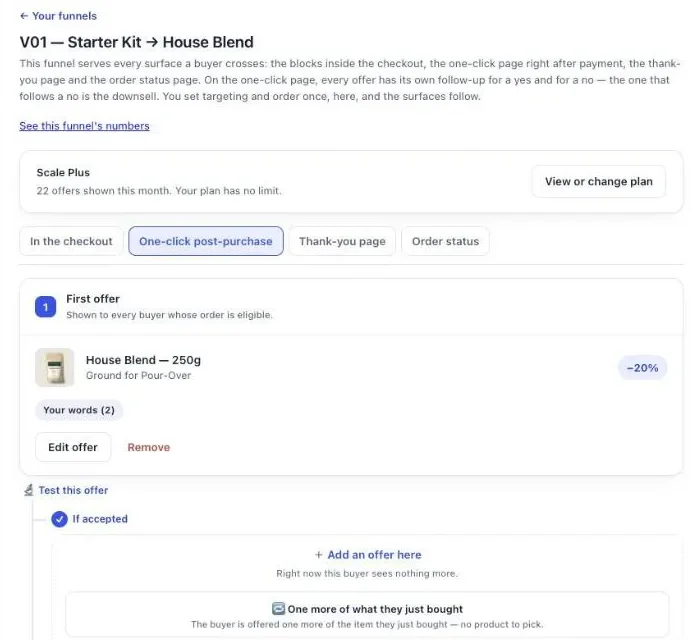
An upsell sells the buyer more of what they chose or a better version of it. A cross-sell sells them a different product that goes with it. On a burger order, the large size is the upsell and the fries are the cross-sell.
After checkout the line moves a little. On Shopify’s post-purchase page, an offer is added to the paid order, so the strongest upsell there is the same item again, at a lower unit price, and the cross-sell is the product the buyer will need next. In Post Purchase Upsell Abakira those are two offer types: One more, same variant (or One more, any variant) for the upsell, and A product for the cross-sell. This page covers which one to put first, which item the app re-offers, how the two work together in one funnel, and how to measure which one earns more on your store.
What is the difference between an upsell and a cross-sell?
The difference between an upsell and a cross-sell is what the offer changes. An upsell changes how much, or how good, the item the buyer already chose is: a bigger size, a premium model, two units instead of one. A cross-sell adds a separate product that goes with it: filters for a coffee maker, a case for a phone, a mug for coffee.
| Upsell | Cross-sell | |
|---|---|---|
| What it offers | More of the chosen item, or a better version of it | A different product that goes with the chosen one |
| Coffee store example | A second bag of the same House Blend | Paper filters or a mug after a brewing kit |
| What the buyer has to decide | "Do I want more of this?" | "Do I want this new thing?" |
| Classic place before checkout | Product page: size picker, premium model, quantity breaks | Product page and cart: "goes well with", "frequently bought together" |
| Form after checkout on Shopify | Another unit, or several, added to the paid order | A related product added to the paid order |
| Offer type in Post Purchase Upsell Abakira | One more, same variant / One more, any variant (plus Quantity tiers) | A product, or A bundle |
| Product to pick in the admin | None: the item is read from the order | Yes, one product per offer |
Both raise the value of the same order. Neither is “better” in the abstract. Which one wins depends on what you sell and on the moment, and the moment after payment changes the rules more than any other.
How do upsells and cross-sells change after checkout?
After payment, an offer is added to the order the buyer already paid, so the strongest post-checkout offers add something: more of the same item, a product that goes with it, or a longer subscription. As of November 2026, Shopify’s post-purchase changeset supports four kinds of change: add a variant, add a shipping line, set a metafield, add a subscription.
In practice, that gives three offers:
- More of the same. A second bag, a refill, a spare. This is the post-checkout upsell, and the buyer’s decision was made thirty seconds ago.
- A related product. The cross-sell. The buyer judges something new, so the price has to be easy.
- A longer subscription. For a buyer who just subscribed, the upgrade is a longer commitment rather than a different product. That one runs through the subscription app, as we explain in upgrading a subscription right after purchase.
The “better version” upsell belongs on the product page, before payment. After payment, sell the add-on that makes the purchase better: the premium accessory, the larger refill pack, the second unit.
The other thing that changes is the price you can ask. Our guide’s rule for the page after payment: an offer priced at roughly a quarter to a half of the order gets considered as an impulse, and an offer priced near the order total gets refused. The repeat is the exception, because the buyer isn’t deciding again. A $22 repeat after a $24 order still gets taken. That single exception is why the upsell and the cross-sell don’t obey the same pricing, and it’s covered in the guide chapter on what to offer after checkout.
Which one usually wins after checkout: more of the same or a related product?
More of the same usually wins after checkout. On a store that sells products people use up, the first offer that earns most is the item the buyer just ordered, again, at a lower unit price. Our own guide calls the repeat “boring, and often the best performer in the shop” for consumable products.
The reason is the decision. A cross-sell asks the buyer to imagine a new object in their kitchen. A repeat asks one question, “another one at this price?”, about something they already chose and paid for. The classic wording, “double your order”, describes a quantity, not a product.
“Usually” is the honest word, and it has a clear boundary: products people use up. Coffee, supplements, skincare, pet food, candles, refills, socks. On a product that people buy once (a grinder, a kettle, a jacket), a second unit has no obvious use and the cross-sell takes over. Our page on the same product upsell covers the repeat offer in depth: wording, discount table and quantity tiers.
Which item does a repeat offer re-offer when the order has several products?
A repeat offer in Post Purchase Upsell Abakira re-offers the line with the highest price per unit in the paid order. On an order with an $80 serum and a $2 sample, that’s the serum. When prices are equal, the first line of the order wins. The item comes from the order lines Shopify signed at checkout, so the buyer’s browser can’t change it.
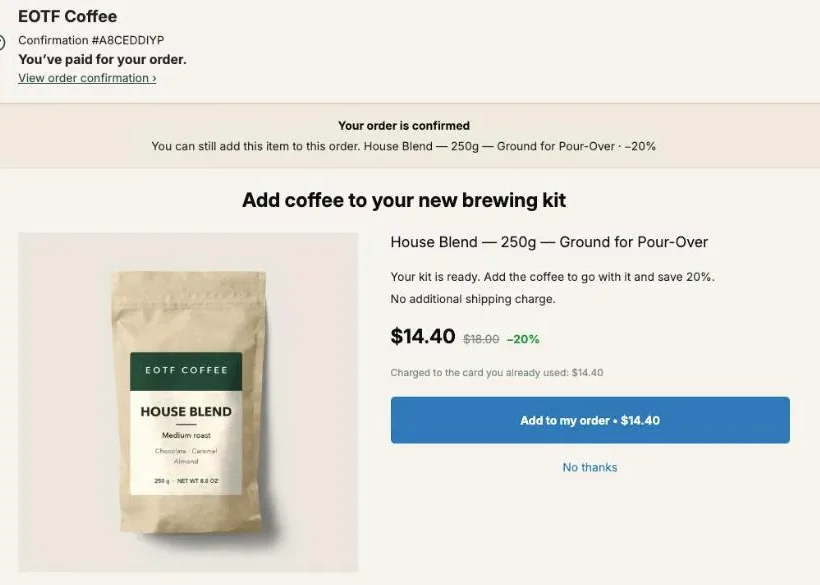
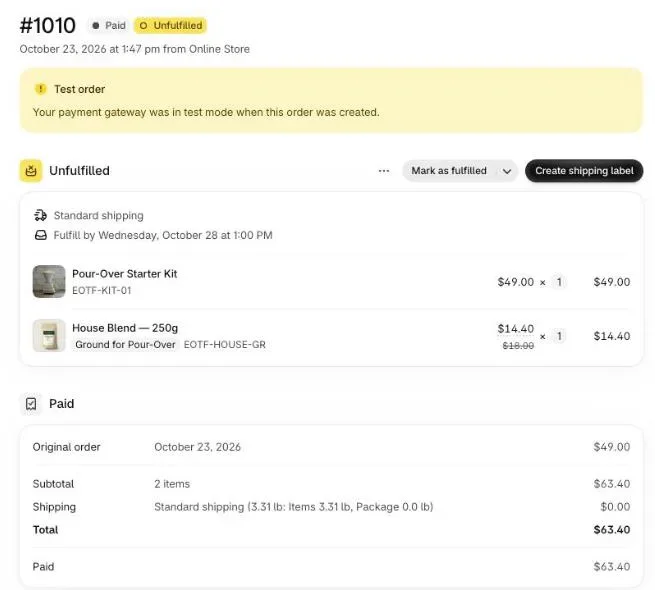
This rule decides more than it seems when you choose between an upsell and a cross-sell. Take our demo store’s test order #1010: a Pour-Over Starter Kit at $49. A repeat offer on that order re-offers the kit, a second $49 brewing kit, which almost nobody needs. A cross-sell offering coffee at $14.40 is the right first offer there, and it’s the one the order shows: kit plus coffee, $63.40, one order.
Now take an order of one $18 bag of House Blend. The repeat re-offers that bag, and the upsell is the natural first offer.
Most stores have both kinds of order. Three ways to handle it:
- Repeat first if most orders are consumables. One offer covers the whole catalog, because the item comes from each order.
- Cross-sell first if most orders are durable goods, with a product you pick for its fit.
- Two funnels, one for orders that contain your durable products, with a cross-sell, and one for everyone else, with the repeat. Targeting a funnel by what the order holds uses the Order contains condition, and more than one funnel needs a paid plan.
How do I pick the right cross-sell product?
The right cross-sell product after checkout is what the buyer will need once they start using what they bought. Filters and coffee after a brewing kit. Wax after a snowboard. A refill after a starter pack. Name that next problem in the offer’s text, and price the item well below the order: around a quarter to half of its value.
Three checks before you pick:
- Stock and shipping. An out-of-stock product is hidden by the app rather than sold, so a thin stock quietly earns nothing. The item ships in the same parcel with no second shipping charge to the buyer, so a heavy item can cost you more in postage than it earns.
- Not a new decision. A different color of something they didn’t buy is browsing. The cross-sell completes what they bought.
- Your own sales. If you’d rather not guess, let the data pick. When Post Purchase Upsell Abakira builds a starter funnel, it reads the last 60 days of orders, picks your best-seller priced at or below your average order as the first offer, and fills If accepted with the product most often bought together with it. That’s a cross-sell chosen from your own baskets.
For buyers who want to choose a flavor or color of the cross-sell product, see letting the buyer pick the variant.
The full method, moment by moment, is in what to upsell after a purchase.
Can I run an upsell and a cross-sell in the same funnel?
You can run an upsell and a cross-sell in the same funnel, and that’s how the strongest funnels are built. The first offer is one type, and the follow-ups after a yes or a no use the other. A funnel in the app holds up to three offers in a row for one buyer, so there is room for both.
Two orders that work:
| Your catalog | First offer | If accepted | If declined |
|---|---|---|---|
| Mostly consumables | Upsell: One more, same variant, 15-20% off | Cross-sell: a companion product (filters, a frother) | Same item, deeper discount |
| Mostly durable goods | Cross-sell: the product bought most with it | Another cross-sell, or a consumable that goes with it | The same cross-sell at a deeper discount, or a cheaper item |
The starter funnel in Post Purchase Upsell Abakira follows the second pattern: first offer at 15%, the bought-together product at 15% if the buyer says yes, and the first offer’s product again at 25% if the buyer says no. Our page on how deep to cut after a no explains that gap.
In the funnel editor, every empty slot under If accepted or If declined shows two buttons: Add an offer here, to pick a product, and One more of what they just bought, for the repeat. That’s the upsell and the cross-sell side by side, one click each.
On the free plan, a funnel shows the first offer only (follow-up offers are saved and switch on with a paid plan), so you choose one type per period and compare, as described below.
Where do cross-sells go when the buyer skips the one-click page?
Cross-sells for buyers who skip the one-click page go on the thank-you page. The thank-you page is where buyers land after checkout, including the ones who never see the one-click page, and Post Purchase Upsell Abakira can put a single product, a carousel or a bundle there. A bundle block is a natural cross-sell: three products that complete the purchase, sold in one tap.
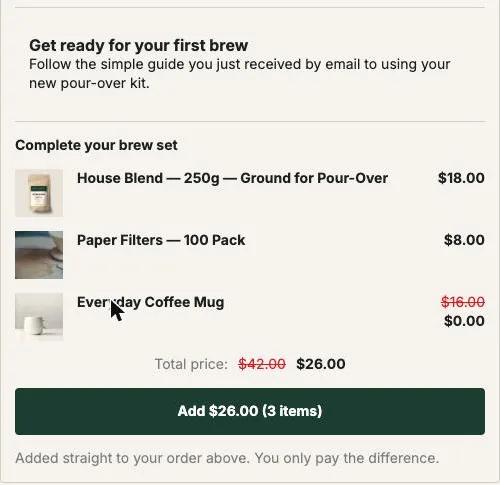
The upsell works there too. A product block can carry quantity tiers, so a buyer who missed the one-click page can still take two or three units at a lower price. How a thank-you offer joins the same order is covered in the thank-you page upsell on Shopify.
How do I measure which one earns more on my store?
You measure an upsell against a cross-sell with net revenue per view: what an offer earned divided by how many buyers saw it. Acceptance rate alone misleads, because a cheap cross-sell gets accepted more often than a second unit of an expensive item and can still earn less. Compare the two on the same slot, over the same kind of traffic.
Post Purchase Upsell Abakira gives you three places to read it.
The funnel’s own page. On the Results screen, each funnel opens its own page with figures on every offer: shown, accepted, revenue. A repeat offer appears under its own name, “Same item the buyer just bought” or “Another one from the product just bought”, so it reads next to your cross-sell steps without confusion. The guide chapter on reading your numbers shows where each figure lives.
The By product table. The Results screen has a By product table over the last 30 days, every page included, with columns Saw it, Orders, Units, Revenue, Share and Clicks (the Clicks column counts from November 5, 2026). A repeat offer sells whatever the buyer bought, so its sales land under each real product. That’s how you see which items get re-bought and which never do. If one durable product keeps showing up as a repeat with few sales, give its orders a cross-sell funnel.
An A/B test. The cleanest answer is a test on the same slot. Click Test this offer on the first offer and add a version. Each version has its own What this offer proposes, so version A can be One more, same variant and version B A product, each with its own discount. Pick the goal Net revenue per view. The app splits buyers between versions and says “Too early” until it has enough purchases, then names the winning version, with its confidence, or reports a tie. A/B testing is on the Scale plan; our page on A/B testing a post-purchase upsell walks through the setup.
Without the Scale plan, run the two types one after the other: two weeks with the repeat as the first offer, two weeks with a cross-sell, and compare revenue divided by the number of buyers who saw the offer, read from the funnel’s page (saw it, accepted, revenue). Only the A/B test shows Net revenue per view as a ready-made figure; here you divide it yourself. Keep the discount the same in both windows, so only the offer type changes. The same before/after method, applied to a cart offer, is laid out in cart upsell vs post-purchase upsell.
What does this look like with real prices?
The math on our demo store’s catalog shows why the two types need different discounts. Prices are the store’s list prices: a $49 Pour-Over Starter Kit, an $18 bag of House Blend.
| Order | Offer | Type | Buyer pays | Order becomes | Increase |
|---|---|---|---|---|---|
| Kit, $49 | House Blend at 20% off | Cross-sell | $14.40 | $63.40 | +29% |
| Kit, $49 | A second kit at 20% off | Upsell (repeat) | $39.20 | $88.20 | +80% |
| One bag, $18 | A second bag at 25% off | Upsell (repeat) | $13.50 | $31.50 | +75% |
| One bag, $18 | Paper filters, $8, at 15% off | Cross-sell | $6.80 | $24.80 | +38% |
On paper the repeat lifts the order more every time. In practice the second kit is a $39 ask after a $49 purchase, close to the order’s own value, which is the price range the ratio rule says gets refused. The second bag of coffee asks for a similar share of its order, but it’s a consumable, and that’s the exception. So for the kit order, the cross-sell is the offer that will get taken; for the coffee order, the repeat. Your own figures on the funnel page will tell you whether that holds for your catalog.
For where post-purchase offers sit among the other ways to lift order value, see what raises average order value on Shopify, or browse the other upsell methods on this blog.
Post Purchase Upsell Abakira has a free plan with up to 100 offers shown a month, with both repeat offer types and product offers included. The listing has the current plans.
Set up an upsell and a cross-sell in one post-purchase funnel
- Open the one-click tab In Post Purchase Upsell Abakira, open your funnel and select the One-click post-purchase tab.
- Choose the first offer type Click Edit offer on the first offer. Under What this offer proposes, choose One more, same variant or One more, any variant for an upsell, or A product for a cross-sell, then pick the product.
- Set the discount Set a percentage discount: 15 to 25 is the range the app's starter funnel uses.
- Fill the If accepted branch with the other type Under If accepted, click Add an offer here for a cross-sell product, or One more of what they just bought for a repeat. Follow-up offers need a paid plan.
- Fill the If declined branch Under If declined, add the same product at a deeper discount, or a cheaper item.
- Save and test Click Save, place a test order with a card, and accept the offer. The added item appears as a new line on the same order in your Shopify admin.
Frequently asked questions
Is a bundle an upsell or a cross-sell?
A bundle is a cross-sell when it adds products the buyer didn't choose, like coffee, filters and a mug after a brewing kit. It turns into an upsell only when it sells more of the item already bought, such as a three-pack of the same refill.
What is the difference between a downsell and an upsell?
A downsell is the offer a buyer sees after saying no to the first one. It is usually cheaper: the same product at a deeper discount, or a smaller item. In Post Purchase Upsell Abakira it sits under If declined, and the starter funnel fills that slot with the first offer's product at 25% off instead of 15%.
What is suggestive selling, and is it the same as cross-selling?
Suggestive selling is the light version: a quick, cheap add-on mentioned in passing, like batteries with a toy. Every suggestive sell is a cross-sell, but a cross-sell can also be a planned offer with its own page, price and discount, which is what a post-purchase offer is.
Do I pay extra shipping when a buyer accepts a cross-sell after checkout?
No second shipping charge is added to the buyer. The accepted item joins the paid order and ships in the same parcel. Your own cost still goes up with the weight, so check that a heavy cross-sell keeps a margin after shipping.
Can I upsell a subscription after checkout?
Yes. Post Purchase Upsell Abakira has a Subscription upgrade offer type that lengthens the buyer's existing subscription through Loop or Recharge, so there is no second subscription. It needs the subscription connector, which comes with the Scale plan.
Related articles
Written by Abakira. We make small software: Shopify apps, web tools and iPhone apps. This article is about Post Purchase Upsell Abakira.