Part 2. Raise the cart
5 What to offer, the chapter that decides your revenue
Every setting in this app matters less than this one choice. The three offer types that work, the price ratio that governs acceptance, and the mistakes that kill it.
You can spend a week tuning discounts and timers. It will move your numbers less than changing which product you put in front of the buyer. This is the chapter to reread.
Three offers that work
The companion. Something the buyer needs because of what they just bought. Wax for a snowboard, a case for a phone, filters for a machine. It works because you are not asking them to reconsider anything, only to complete a decision already made.
The upgrade. More of the same, or a better version. Two instead of one, the larger size, the bundle. It works when the buyer already liked the product enough to pay for it thirty seconds ago.
The repeat. The same item again, for people who buy consumables. Coffee, supplements, skincare. Boring, and often the best performer in the shop.
The price ratio, which governs everything
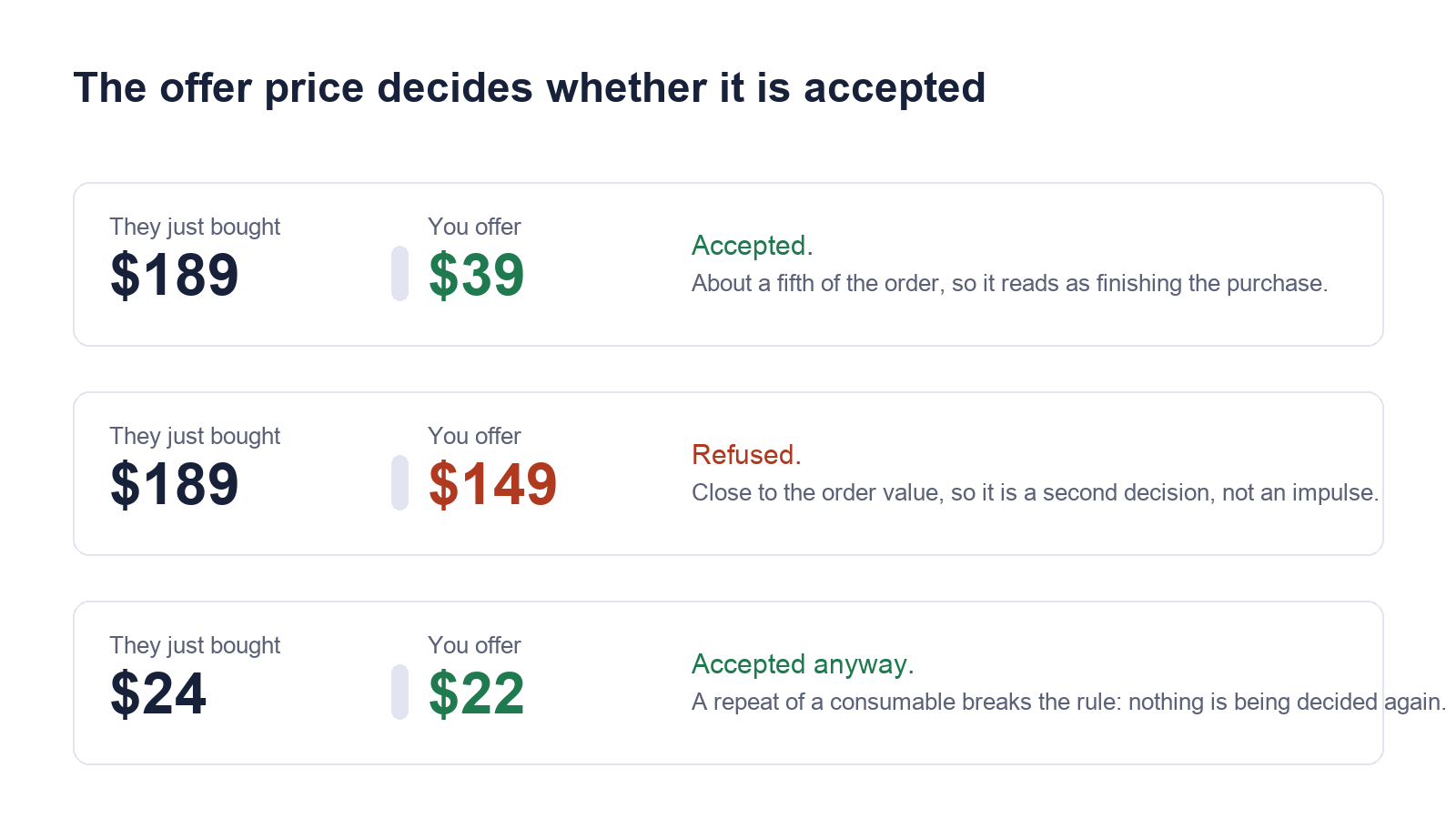
An offer priced well below what the buyer just spent gets accepted. An offer priced near or above it gets refused, almost regardless of how good it is.
Aim somewhere around a quarter to a half of the order value. A buyer who just spent 200 will consider 40 without much thought. The same buyer will not take 180 as an impulse, because 180 is a decision, and decisions need a shopping session, not a button.
If your only offer candidate is expensive, this is where quantity tiers and a real discount earn their keep. Chapter 8 covers both.
The four mistakes worth naming
Offering what is already in the cart. The buyer bought it. Showing it again reads as a system that is not paying attention, and it costs you the slot.
Offering a decision. A different colour of a product they did not buy, a competitor of the one they chose. That is browsing, and this is not the moment for browsing.
Offering something out of stock. The app hides the offer rather than selling what you cannot ship. That is correct, and it means a poorly stocked offer quietly earns nothing.
Offering something heavy. The item joins the paid order without a second shipping charge. That is good for the buyer and good for conversion, and it means an offer whose shipping costs more than its margin loses you money on every acceptance. Check the weight before the price.
Pick three candidates, not one. You will need them in chapter 11, when you test one offer against another. Choosing them now saves you from inventing a comparison later just to have something to test.
What you should have now
A shortlist, in order, with a price against each one and a note of what it weighs. If your first funnel from chapter 4 is not holding the top candidate, change it now.
Last updated